

American Oasis
On the Cultural Legacy of "Tales from the Mall"

Note: This was posted on X on September 8th. Brendan has since announced the show will be ending.
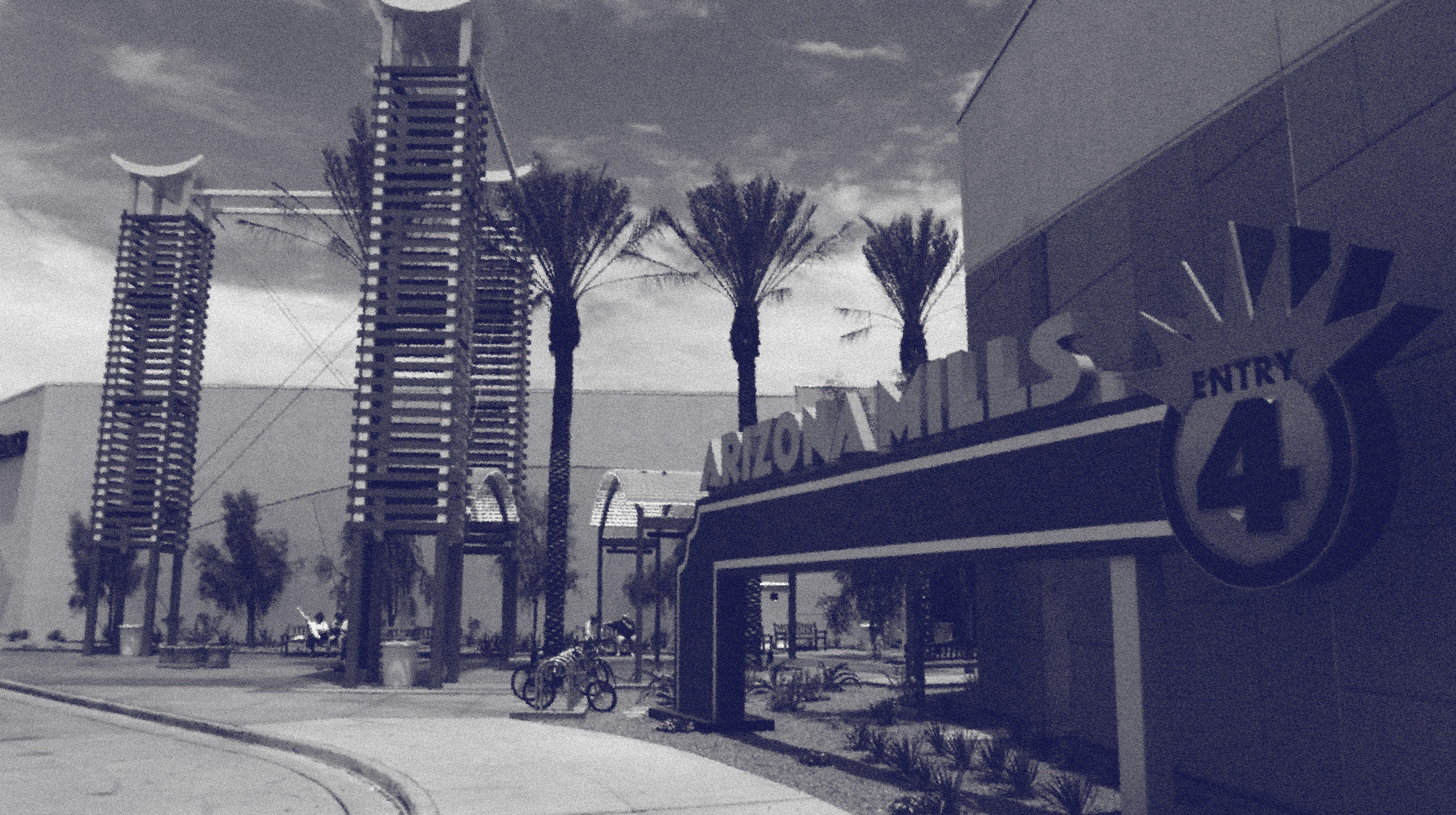
It’s 101 degrees today in Phoenix. You’re getting in your car to drive to the mall. Maybe Arizona Mills, maybe Scottsdale Fashion Square, maybe Desert Sky. You parked without shade, and the Sun’s been cooking the driver’s seat. It burns your skin, so you gayly arch your back and lean forward while you steer. You blast the AC but it takes time to cool down, so the initial gust air-fries your face. Convection-burns your sclera. You direct the vents downward and it goes up your shorts. Your clothes are beginning to stick to you. Beads of sweat down your back. There’s no one walking on the sidewalks — no one except one man. His name is Brendan, and he is nude.
He’s also going to the mall, to record Tales from the Mall. An unedited, uncensored series of long-form call-in interviews. Now in its fourth year with a 200-episode catalogue, the show has become an institution, and deserves to be canonized among the great experiments in post-radio broadcasting.
Every episode opens with chimes. They smoothly echo until the bass drops and Brendan begins his opening stream-of-consciousness monologue. “Do you feel what’s happening to you right now? Do you feel it? Does it feel like a warm embrace?” Brendan casually asks his listener on episode 46 with @illegalth0t, “Because it is a warm embrace. I’m hugging you. I’m giving you love. And you should just accept it. There’s no strings attached. I’m not asking anything of you,” he continues in front of the hypnotizing lo-fi beat. “Well okay, I’m asking one thing of you, and that is to keep listening to Tales…” He pauses erotically, “…from the Mall.” The intro has a tranquilizing effect, dialing back your mileage and opening your mind to incredible possibilities.
Then you hear a ring, and the guest picks up the phone. “I have to tell you something,” he always says, “You’re on Tales From the Mall.”
By beginning each interview with this same statement, Brendan creates a fascinating Rorschach test for his listeners to observe. A covert personality check. Some guests simply acknowledge the fact, others celebrate. Some feign shock, as a joke, since of course they agreed to come on the show. “No way!” they’ll say. “Way,” he’ll respond.
The tone and character of their answer often eerily encapsulates the episode as a whole. “Where did you come up with that title by the way?” responded @walterkirn, eagerly, on episode 158, which Brendan explained was an homage to the 2012 novel of the same title by Ewan Morrison (who’s since been on the show). “Thank you for having me on,” replied Sam Pink, with curt formality, on episode 53. “Are you in Florida?” Brendan then asked him. “Forget about Florida,” Pink demanded, “Just forget about Florida. It’s over.”
Like a recreational window shopper, Brendan wanders through his interviews, peeking into his guests’ emotional storefronts and calmly assesses their wares. On episode 10, with @Howlingmutant0, Brendan drifts from the Toronto Pickup Artist Schism of 2012, to whether they’ve ever banged a hooker, to the Body Count Question. “I don’t care personally how many guys they’ve slept with,” answers Mutant, “It’s the race of the guys they’ve slept with.”
Often, the podcast is the first time Brendan has ever spoken with the guest. This requires him to introduce and interview simultaneously. Thus the listeners get to know Brendan well, and can often anticipate his answers, his touchy subjects, and his repertoire of references. The listener meets the guest alongside Brendan, perceiving them with parasocial synchronicity. This is brave of him, and interesting, the nakedness with which he bares himself. You learn, for example, that Brendan had a multi-year sexual dry spell. Then, in episode 54, hear him confess this to @Delicious_Tacos, who is hilariously stunned. You similarly track his commitment to sobriety, which comes up often, and like the intro statement elicits a novel and revealing response from each new guest. Brendan’s commitment to honesty is arresting yet relaxed, and its reciprocal effect on his subjects gives the show its remarkable authenticity.
Another recurring topic is where people are from, where they went, and whether they like it there. Brendan has a unique fascination with his guests’ geographic origins. How they respond to contrasts in architecture, density, and climate places them within the frame of Tales’ expansive American portrait.
In fact, the show is uniquely American, and pays tribute to a uniquely American institution. Tales presents malls as sacred energy vortexes, sites of social pilgrimage among our sprawling municipalities. Destination ecosystems. Commercial villages. Brendan’s elliptical episode promos, which navel-gaze at the mall’s internal textures, capture something zen about these vast retail cathedrals.
Brendan’s a millennial, but his sensibility blends Gen X informality with Zoomer irreverence. The Xers having been the original mallrat generation, and the Zoomers being the recent re-adopters who nostalgically bask in their retro liminality. Brendan himself seems pulled from a scene in Waking Life, a Linklater character who strolls around commercial suburbia having airy conversations with his slacker-cast of mutuals. E-girls. Musicians. Self-published Amazon authors. Brendan journeys, Twain-like, through a contemporary carousel of digital archetypes.
Though the mall isn’t always acknowledged or interacted with, its backdrop gives the show an imaginative sense of cultural geography, and allows the listener to project visual flourishes from their own local malls onto its kaleidoscopic canvas. You picture him moving through Macy’s, through Nordstrom, through the Gap. That the whole show has been conducted from the mall, inconspicuously, is a sondering jolt from our careless denial of others’ interiority. That its catalogue is being actively constructed by a stranger, who could pass you by in front of Wetzel’s Pretzels, is the core of the show’s lithe spirituality.
Very little from this artistic dark age will survive into posterity. Our culture has become a desert parking lot of littered ephemera. We emerge from our cars, alone, into the hostile dry heat of the attention economy. It sizzles with indifference, and with the rising shepherd’s tone of some slyly approaching extinction. We are parched. There’s no water. And yet in the distance stands a great American Oasis—Tales From the Mall—with its air-conditioned wisdom, walkable pace, and mysterious intimacy.